International Day of Families
By
Nepali Patro (Sudan Bhattarai Upadhyaya)
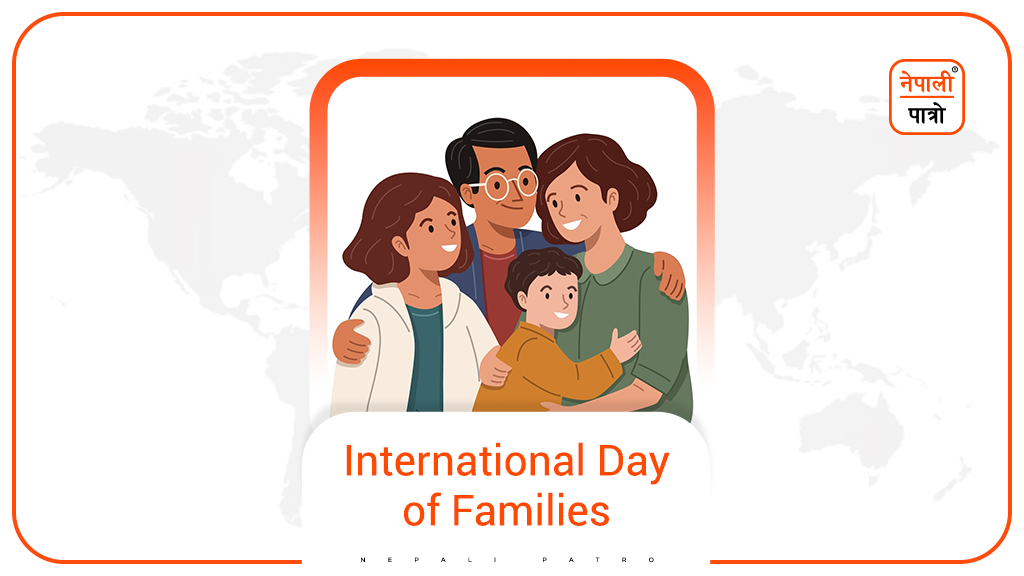
“International Day of Families is observed on the 15th of May every year worldwide to mark the importance of Family and its unity along with health care and mutual living. The Theme for the year 2025 is “Family-Oriented Policies for Sustainable Development: Towards the Second World Summit for Social Development.”
The concept of the family day arose in 1980 when the United Nations started focusing its attention on issues related to the family and its welfare. In the year 1983, the UN Commission for Social Development, based on the suggestions of the Economic and Social Council, in its resolution about the Role of family in the development process, requested the UN Secretary General to enhance awareness among decision-makers and the public about various problems and the need of the family, as well as different effective ways to meet those needs.
On 29 May 1985, the Council invited the General Assembly to consider the provisional agenda of its forty-first session with an article entitled “Families in the development process”, which was with the view of requesting the Secretary General to initiate the process of development for global awareness about the issues involved, intergovernmental and non-governmental organizations as well as public opinion in the general. On 9 December 1989, a new resolution was passed on, and the UN General Assembly proclaimed “The International Year of the Family”.
In 1993, the UN General Assembly decided that 15th May of every year should be observed as “International Day of Families” to promote awareness of family issues and increase knowledge of the socio-economic and demographic processes that affect families in different developed and underdeveloped countries.
On 25 September 2015, the 193 member states of the United Nations unanimously adopted the Sustainable Development Goals (SDG), with a set of 17 goals aiming to eliminate poverty, discrimination, abuse, and preventable deaths, addressing environmental destruction, and a guide in an age of development for all people, everywhere in the world.
The problems arising in this fast-paced world sharply focus the importance of investing in social policies protecting the most vulnerable individuals and families. It is the families who bear the impact of any problems, sheltering their family members from harm, caring for school-going children, and continuing their work responsibilities.
For the achievement of these goals, set forth in the Sustainable Development Goals (SDGS), families and family-oriented policies and programs are vital. There is a real opportunity to rethink and transform the way our economies and society function to foster greater equality for all. In doing so, gender equality will not be achievable without greater equality in families; thus, this day continues to provide a visionary roadmap of where we need to go further.
After the freedom of Nepalese from the Monarchy until the open-speech Republic days, the importance of family and its unity, different kinds of problems arising within a family, sheltering of the family, etc., also became one of the key factors of all families in general. Thus, fostering and promoting the importance of family, its unity, and how to cope with the problems arising from different factors have been seen as key factors for the implementation of a better family in every household.
Though here in Nepal, the concept of “International Day of Families” may be new to a lot of people in general, slowly, people are becoming aware of its importance, and people observe this day with great zest. However, the governmental and non-governmental bodies still lack programs and initiatives to make better families all over the country. Providing basic necessities and even shelters in remote areas for families can be seen as a challenge for the current government and their bodies, which need immediate attention to foster the importance of family and solve problems related to them.
Without hope, there is no dream and no further planning. Thus, let us hope this year’s “International Family Day” can open the eyes of policymakers, government, and non-government bodies to making new rules and regulations and implementing those rules for the betterment of every household and every family living in different conditions and situations around the whole country.
To Read this article in the Nepali Language please click here.